
Introduction
Hi, my name is Ramon. I am Brazilian, and because I am Brazilian, I understand the country’s cultural codes. That’s why I am writing this article with complete honesty, pointing out both the positive and negative aspects, for anyone who is planning to visit Brazil or is interested in doing so. I will write this as if I were giving advice to a friend.
Podcast format:
Arriving in Brazil
First, I want to talk about fairness and paying what is reasonable. When you arrive in Brazil, you will quickly notice that airport prices are extremely high. I don’t know why, but prices are often three, four, or even five times more expensive than normal. If you want to save some money, bring a snack in your bag. If you want to buy souvenirs from Brazil, try to buy them in the city. Only buy things at the airport as a last resort.
When leaving the airport, you need to stay alert. Try to arrive during the daytime if possible. At night, it can be more dangerous depending on where you are coming from. If you are going to Rio de Janeiro, try to land at Santos Dumont Airport (SDU), which is closer to downtown, hotels, and tourist attractions. I have never been to the other airport, but everyone says it is far from everything and requires passing through more dangerous neighborhoods.
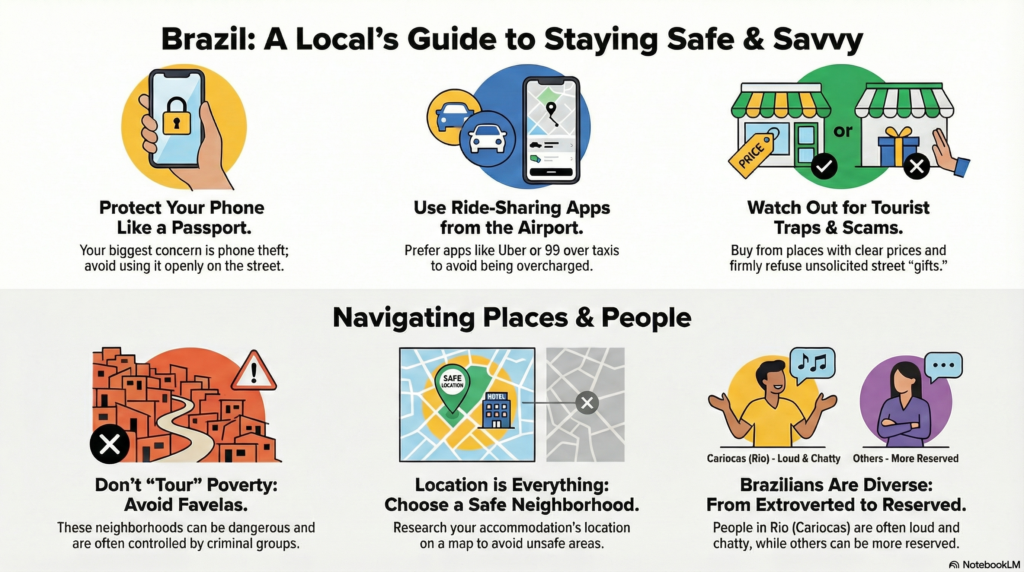
In Brasília, someone once tried to scam me with transportation. The app price was one amount, but the driver wanted to charge me double. Even if prices seem cheap to people who earn in a strong currency, always check the market price. Give priority to apps like Uber and 99. I do not trust taxis very much. Unfortunately, some drivers are dishonest, and when they transport foreigners, some try to take advantage if they realize you do not know the city. If a taxi is the only option, be firm. Show that you know where you are going and how long the ride should take. If you want to avoid this headache, some hotels offer airport pickup services.
In summary, try to arrive during the day, bring a snack to avoid overpriced airport food, and already have Uber or 99 installed to get to your accommodation. That usually works well.
Safety in Brazil
Brazil is dangerous. If you did not know that before, now you do. However, it is not a war zone. You will see people living their lives, enjoying the beach, having fun, and many visitors say, “Wow, it’s not as dangerous as people said.” You can have great moments, but it is not a place to let your guard down.
Your biggest concern as a tourist should be your phone. Avoid using your phone on the street, especially if it is an expensive device, like the latest iPhone models. Yes, you will see many people in tourist areas, such as beaches, holding their phones, recording videos, chatting, and taking pictures. But as friendly advice, do not be careless with your phone. Those people are taking risks, because someone may be watching and looking for victims to steal from.
I know this also happens in Europe, with pickpockets. I have seen viral videos from Italy and France. You should be even more careful if you are alone.
Prices and Avoiding Scams
If you visit during school vacation periods, such as December, January, February, Carnival season (which varies but usually happens in February or March), or July (winter school break), these are high-season months. Prices are higher during these periods. If you want more nightlife and crowds, these are good times to go. If you are like me and do not like crowded beaches and packed places, choose other months.
Just be careful, because in some regions, such as beaches in the Northeast, it may be the rainy season. Always research before traveling so you don’t end up stuck at the hotel without enjoying your trip.
Unfortunately, in very touristy places like Rio de Janeiro, if people notice that you are not local, they may charge you much more. I am Brazilian, but I lived in another region, and because my accent is different, they can tell and may try to charge me more than they would charge a local from Rio. For foreigners, it is even worse.
To avoid this, buy from places that clearly display prices. Beach kiosks usually have menus with prices. You can also buy snacks, water, and juice at supermarkets, bakeries, or pharmacies and bring them to the beach. You will save a lot of money.
Another place that many people complain about is Salvador. Some people try to paint you or put bracelets and accessories on you, saying it is a gift, and then later demand payment. Avoid these interactions. You need to be firm when saying no.
Two other places that are very controversial regarding scams are Municipal Market in São Paulo, where vendors sell fruit at absurd prices and use persuasive talk. The prices are often listed in very small letters per 100 grams (3.5 oz), not per kilogram (2.2 lb). Another place that recently became controversial is Porto de Galinhas beach, where people agree on a price and later try to charge more.
In Brazil, cash is not used as much anymore. Many people use Pix, which is a digital payment system, or credit and debit cards. It is very common to see street vendors with card machines. For street vendors, it is better to carry small bills and pay in cash. In stores and restaurants, using a card is usually fine.
If you buy something from a street vendor, always check the amount before paying. I have seen cases where something costs R$10 and the vendor charges R$1,000. If you notice that a very high amount was charged, contact the police immediately and go to a police station to report it and try to block the transaction. Follow these tips so money issues do not ruin your trip.
Visiting Favelas
I believe some people lack a sense of reality and end up glamorizing favelas. Favelas are poor neighborhoods, and many people live there out of necessity. These areas are often underserved by the government. Most residents are hardworking people doing their best to survive. However, these areas are often controlled by drug traffickers, militias, or criminal groups, so the danger should never be underestimated.
I would advise a friend not to visit. Anything can happen at any moment, including conflicts between criminal groups or police operations. If you take photos of the wrong thing or if a criminal sees you as suspicious or simply does not like you, the situation can go very badly.
If you insist on going, at least support the local community by consuming local services. Go with a tour guide and never go alone. I find it disturbing when tourists go into favelas in vehicles that look like safari tours. That crosses the line into lack of humanity. These are real people living there. I also do not understand this fascination with observing poverty. People do not visit the poorest neighborhoods in New York, Los Angeles, or Paris just to see how people live.
As a Brazilian, I know people from many social classes. I have been to favelas, but always with a purpose and with trusted local contacts. My mother is a social worker and has supported social projects in these communities. I would never visit a favela just for sightseeing.
Brazil is not a country where you can wander around without a plan, especially in big cities. Research neighborhoods in advance to avoid getting into dangerous situations.
Accommodation
Choosing where to stay is extremely important. Sometimes cheap accommodations can end up being very expensive in other ways. As a tourist, I would avoid staying in favelas or peripheral neighborhoods. It is better to spend a little more and stay in safer, more developed areas.
Due to Brazil’s urban and social structure, there can be a huge difference between neighborhoods. I sometimes see videos of people shocked after discovering that their accommodation is located inside a favela. This can usually be avoided with proper research. Use Google Maps, enter the address, and check the surrounding area.
Nightlife
Once again, Brazil is a dangerous country. Even if everything looks like fun and parties, do not let your guard down. As a tourist, I would enjoy daytime activities like going to the beach, visiting restaurants, and seeing tourist attractions. At night, I would be more cautious.
If you want to go out at night, stay in busy areas and choose accommodation close to where you are going out. The biggest risk is leaving a busy area and walking into an empty one, especially late at night when most people are asleep. Criminals often target quiet streets. The risk is even higher if you are alone and using your phone in public at night.
Food
Most people enjoy Brazilian food. Brazil is a country where you can eat well for a reasonable price. There are self-service restaurants, pay-by-weight restaurants, and fixed-menu restaurants. In my opinion, menu-based restaurants usually prepare better dishes, while self-service and pay-by-weight options tend to be simpler.
Some restaurants charge a 10 to 20 percent service fee, but it is optional, and you can ask to remove it if you want. It is easy to find quick snacks at bakeries and snack bars. Eating right by the beach is usually more expensive, but if you walk a couple of streets inland, prices become much more reasonable.
Most cities have street markets once a week. These are great places to buy fruits and vegetables, often cheaper than supermarkets. If you are visiting with dollars or euros, your purchasing power in supermarkets will be very strong. Sometimes it is also worth buying personal care products at pharmacies, as prices can vary.
If you want to order food delivery, a very popular app in Brazil is iFood.
Brazilian People
Many people fall in love with Brazilians because they are cheerful, festive, and enjoy celebrating life. If you have an emergency, such as falling on the street, people are usually very helpful and will try to assist you.
Brazil is a large country, and each region has its own personality. Many tourists enjoy visiting Rio de Janeiro because people there are more communicative and extroverted. They are open to conversation and tend to be very warm. Cariocas can be intense. Just as intensely as they love, they can also hate. They often speak loudly and use a lot of strong language. Sometimes it sounds like they are arguing, but that is simply the Carioca way. They also tend to be more flirtatious and seductive.
Bahia is another region with very extroverted and communicative people, often compared to cousins of Cariocas. Regions with a strong Afro-Brazilian cultural presence are often more welcoming and warm.
Minas Gerais, where I was born, is also very welcoming and is famous for its cuisine and wood-fired cooking. People from Minas tend to speak more softly and calmly.
I used to live in Espírito Santo, where people are known for not being very welcoming to visitors and not very talkative with strangers. It is very different from Rio.
São Paulo is Brazil’s financial engine, where most of the country’s money circulates. People there are usually in a hurry and not very talkative. Rio, despite being a large city, has many people who are more relaxed and open to conversation.
People in the South, where there is a higher proportion of European descendants, tend to be more reserved. In the North and Northeast, people are known for being more welcoming.
Brazil for Adults
Brazil has all kinds of people. There are conservative and religious people, as well as more liberal ones. Many visitors come to Brazil seeking parties and nightlife. Unlike in the United States, where I live, certain adult services are not illegal in Brazil. However, the risk for foreigners is extremely high.
There have been cases where foreigners were drugged and robbed, including having their bank accounts accessed through their phones. These services can be linked to criminal organizations, so anyone who chooses to engage in this is entering very dangerous territory.
If you step into these darker aspects of Brazilian reality, you multiply your risk many times over. Many substances are illegal, and if you are caught with them, the consequences can be serious.
I would avoid parties in favelas, dangerous neighborhoods, and illegal events. If something happens, locals may know how to react or escape. As a foreigner, you will likely panic and not know where to go.
Many Brazilians, including myself, hate the sexualization of Brazilian women. Some foreigners think Brazil is an endless Carnival. Not every Brazilian celebrates Carnival, and it is a seasonal event. It would be like thinking Americans spend the entire year dressed in Halloween costumes. That makes no sense.
The people dancing in samba parades are performers and artists. It is not how people live their daily lives. Just as not everyone in the United States lives like a pop star on stage, Brazil is not an eternal party. Learn to separate entertainment from reality.
Summary
If you follow these tips, you will save money, avoid unnecessary stress, and reduce risks, allowing you to have a much better experience in Brazil. If you want me to cover any specific topic, feel free to leave a comment and I will respond.
What I Would Buy in Brazil as a Tourist
I will make a list of things I would buy in Brazil as a tourist so you can enjoy the country’s products in the right places.